
Let the wrist rotate. Keep the bundle calm.
A 360° follow bracket for routes where wrist rotation creates torsion. Series 2 is a motion solution first and a protection choice second.
A 360° follow bracket for routes where wrist rotation creates torsion. Series 2 is a motion solution first and a protection choice second.
The series number is a routing decision, not a product grade. Start with the motion and environment, then let the model, bundle and service access narrow the geometry.
Start here when — and stop when.
Good starting point
- The wrist has repeated or continuous rotation and the bundle is accumulating torsion.
- The route crosses complex paths and needs to follow the tool without loading the wrist.
- Stud welding, gluing, spraying or other articulated duties need a predictable path.
- The bundle needs to keep its minimum bend radius while the robot changes orientation.
Not the first answer
- Heavy slag or direct spatter is the dominant risk; start with an outer protection review.
- The robot does several unrestricted turns without a slip ring or a defined turn limit.
- The bracket has not been checked against the actual wrist, fixture and tool envelope.
- A fixed, short and predictable path does not justify the added rotating interface.
Specification boundary.
| Conduit diameter (ID / OD) | φ29 (φ34.5) / φ36 (φ42.5) / φ48 (φ54.5) / φ70 (φ80) mm |
|---|---|
| Connector protection | IP54 |
| Body construction | PA12 conduit + metal rotary bracket |
| Rotation | 360° follow rotation; continuous multi-turn needs a separate review |
| Typical processes | Stud welding, gluing, spraying, complex-path handling |
| Installation basis | Robot flange, J3/J4 anchors, tool interface and full envelope |
| Project release | 3D interference check, 2D drawing, BOM and agreed wear-part list |
Five checks before a drawing is released.
Confirm the rotation
Identify the axis, direction, maximum angle and repeated frequency. Continuous multi-turn is a separate review.
Measure the bundle
Count cables and hoses, measure the assembled outer diameter and record the minimum bend radius.
Anchor the route
Check the flange, J3/J4 fixing points and the space available around the wrist and tool.
Check the envelope
Run the barrel/bracket through the full motion envelope and check collision and service access.
Release the drawing
Agree the interface drawing, BOM, wear parts and a trial-install check before batch release.
Public references with this system.
These are model families in the public reference map. Open a brand to see the available configurations; an engineer still has to confirm the exact variant.
Check your exact modelSelected project context.
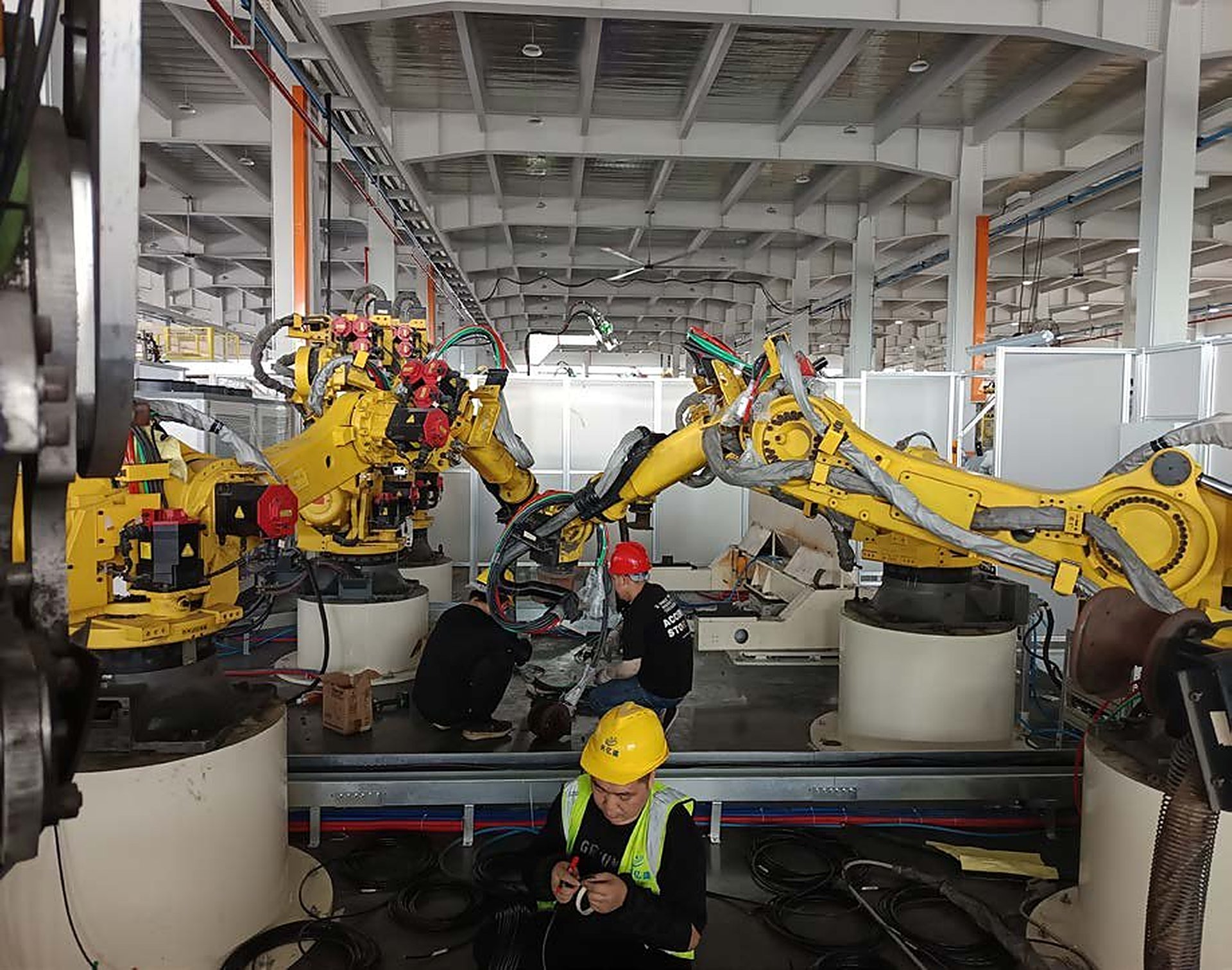 Spot welding
Series 2 on a FANUC spot-welding duty
A public 2014 record using a Series 2 rotary bracket with spare wear parts.
 Handling
Rotary route on a long-reach ABB duty
A public 2023 record using a 48 mm Series 2 route on an IRB 6700 handling application.
Ask before you commit.
Does 360° rotation mean unlimited turns?
No. The bracket can follow rotation through 360°, but continuous multi-turn routing depends on the cable and hose connections and may need a slip ring or a defined turn limit.
Can this system be combined with another series?
Yes. A route can use a rotary bracket at the wrist and a spring or barrel element elsewhere. The combination should be reviewed as one assembly.
Can I select the diameter from the robot payload?
No. Diameter is selected from the assembled cable and hose bundle, its fill and the minimum bend radius. Payload only tells us how much mass the robot can carry.
What do you need for a review?
The exact robot code, tool interface, cable and hose list, photos of the wrist and a motion clip if available. A drawing cannot be released from a brand name alone.
One model. One envelope. One useful answer.
If the robot code is known, we can skip the generic kit conversation and start with the interface.