
One line. Several duty profiles.
Battery lines combine high-cycle handling, dispensing, welding and inspection. The dresspack should follow the station duty, not one line-wide label.
Start with what the route has to survive.
The process creates the environment; the robot and tool create the geometry. A useful dresspack review connects them before a series or diameter is fixed.
High-cycle handling concentrates bending.
Repeated motion can wear a local section first, especially where the cable bundle is tightly packed or poorly supported.
Dust, adhesive mist or cleaning agents vary by station.
The outer layer and moving parts need a station-specific protection and cleaning review.
Short maintenance windows raise the cost of a hidden wear point.
A route that cannot be inspected quickly creates a larger production risk than a slightly heavier accessible design.
Several robot brands and tools share the line.
A common interface logic is useful, but the model-level bracket and cable path still need to be checked separately.
What to start with — and what to challenge.
Start here
- Classify each station as handling, dispensing, welding or inspection, then review the motion and environment separately.
- Use Series 2 for dominant wrist rotation, Series 3 for long stroke and Series 5 when the same stroke must be stored compactly.
- Select the diameter from the assembled bundle and record the bend radius, not only the cable count.
- Plan the high-wear section, outer layer and fasteners as service items.
Challenge before release
- One architecture is applied to the entire line without a station-level motion check.
- "Wear-resistant" is used as a specification without a material and cleaning review.
- The maintenance access is left until after the cell layout is fixed.
- A multi-brand line is planned without checking each robot's fixing points and payload.
The route may need more than one system.
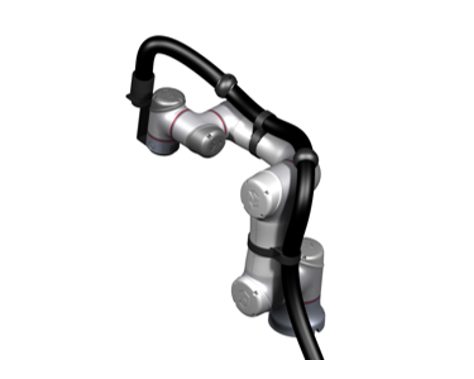
Series 1
Fixed mount
Lightweight handling or transfer stations with a controlled path.
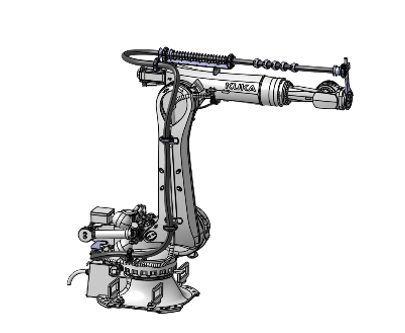
Series 3
External spring
Long-reach loading and unloading where length changes materially.
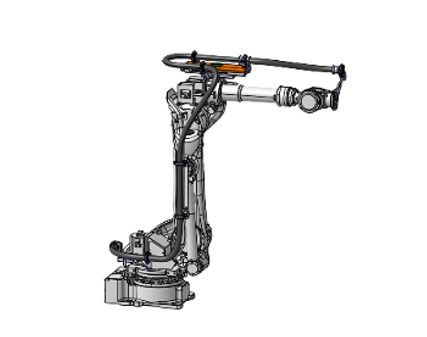
Series 5
Telescopic bracket
High-cycle stations with limited installation space.
What we need to answer usefully.
- Station process, cycle time and robot model for each cell
- Tool, changer, cable bundle and minimum bend radius
- Dust, adhesive mist, coolant or cleaning exposure by station
- Maintenance window and access route
- Common parts strategy across the robot fleet
- Spare wear sections, outer layers and fixing hardware
Before the kick-off call.
Does an EV battery line need a cleanroom dresspack?
That depends on the station cleanliness class, contamination source and cleaning method. It should be reviewed station by station, not assumed for the whole line.
How can cable life be improved on a high-cycle line?
Control minimum bend radius, torsional accumulation, fixing-point load and bundle fill. Validate the route with a running check, not only a static layout.
Why might one line use several series?
Motion, load, tool and service access differ by station. A station-specific route is often more reliable than a line-wide standard.
Which spare parts matter most?
Prioritise the high-wear outer section, fasteners and connector components identified by the station inspection plan.
Start with the robot and the thing that goes wrong.
We will turn the brief into a reference architecture, a list of unknowns and a drawing path.