
Keep the bead steady. Protect the bend.
A dispensing route has to follow the wrist without kinking the adhesive hose, loading the tool axis or making maintenance harder.
Start with what the route has to survive.
The process creates the environment; the robot and tool create the geometry. A useful dresspack review connects them before a series or diameter is fixed.
The gun changes orientation frequently.
Repeated wrist rotation can twist or pinch the adhesive hose before the robot reaches its position limit.
The bead depends on a stable path.
A hose that is pulled tight or sharply bent can affect supply and make the bead difficult to repeat.
Mist and cleaning agents reach the route.
The outer layer and moving parts need a cleaning method that does not damage the hose or connectors.
The tool and robot body are close.
A compact route can solve interference, but it must still leave a service window at the connector.
What to start with — and what to challenge.
Start here
- Repeated wrist rotation is visible; start with Series 2 and keep the adhesive hose separated from the electrical bundle.
- Linear extension or retraction dominates; review Series 3 or Series 5 against the measured stroke.
- The cell is compact; check Series 5 or Series 6 before adding a long unsupported loop.
- The hose, cable and signal line need one route but different bend limits; separate or layered guidance should be part of the design.
Challenge before release
- The adhesive hose is routed through a sharp bend to save a bracket.
- The hose weight is left out of the robot payload and moving-mass check.
- A cleaning agent is assumed compatible without checking the hose and outer material.
- The connector is placed where the operator cannot inspect or disconnect it.
The route may need more than one system.
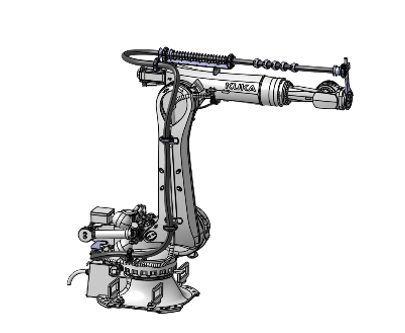
Series 2
Rotary bracket
Wrist-following rotation with controlled bundle path.
Series 3
External spring
Long-stroke compensation when the dispensing path changes length.
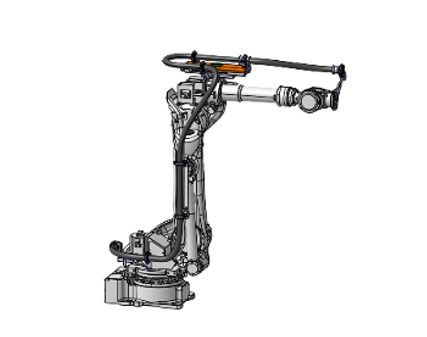
Series 5
Telescopic bracket
Compact storage where the cell envelope is tight.
What we need to answer usefully.
- Robot brand, exact model, payload, reach and controller version
- Dispensing tool, nozzle, changer and full wrist cycle
- Adhesive hose, air line and signal cable diameters, weights and minimum bend radii
- Adhesive pressure, temperature and allowed routing height
- Cleaning agent, frequency and material compatibility
- Service access at the pump, connector, gun and route
Before the kick-off call.
Can the adhesive hose share the bundle with cables?
It can be part of one route, but the hose needs its own bend limit, support and separation from heat or heavy cables. One conduit does not mean one undivided path.
How do we avoid a kink?
Check the complete gun path for minimum bend radius, then adjust the fixing point, bracket direction or guide. A static home-position check is not enough.
Does a rotary bracket change the dispensing path?
The bracket does not program the robot, but its moving mass and hose resistance must be included in the robot load and dynamic check.
What material is suitable for cleaning agents?
Compatibility must be checked against the actual chemical, concentration and cleaning frequency. A generic chemical-resistance table is not a release.
Start with the robot and the thing that goes wrong.
We will turn the brief into a reference architecture, a list of unknowns and a drawing path.