
Protect the envelope. Keep the mass low.
Compact cells and small robots leave little room for a cable loop. The route has to stay short, light and accessible while the tool changes.
Start with what the route has to survive.
The process creates the environment; the robot and tool create the geometry. A useful dresspack review connects them before a series or diameter is fixed.
Robot spacing is tight.
An unsupported loop can interfere with adjacent equipment even when the robot itself is inside its envelope.
The robot has limited mass margin.
Brackets, outer layers and long cable loops reduce the payload available for the tool and affect dynamic performance.
The tool is changed frequently.
The cable route must leave enough slack and a clear connector path for the change, without allowing the bundle to swing.
Several small robots work close together.
Each robot's motion envelope and the shared cell space need to be checked together.
What to start with — and what to challenge.
Start here
- Start with Series 1 for a short, fixed and predictable route on a collaborative or small six-axis robot.
- Use Series 5 when the route must store length in a compact space.
- Review Series 6 when the route must follow the robot body and remain easy to open.
- Check the exact flange and J3/J4 points; similar-looking collaborative robots are not interchangeable.
Challenge before release
- A long unsupported loop is added because it is easy to install.
- Heavy outer protection is added to a robot with little payload margin.
- The cable is left to move freely around a quick-change tool.
- One robot's route is copied to a different brand with different fixing points.
The route may need more than one system.
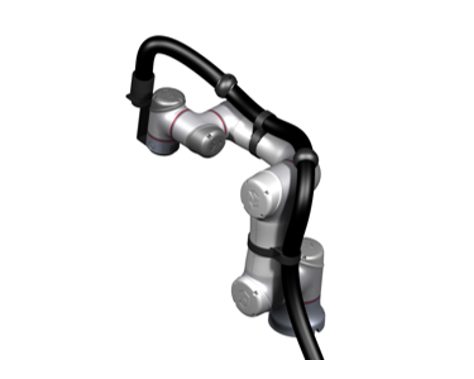
Series 1
Fixed mount
Lightweight routing for compact tools and controlled paths.
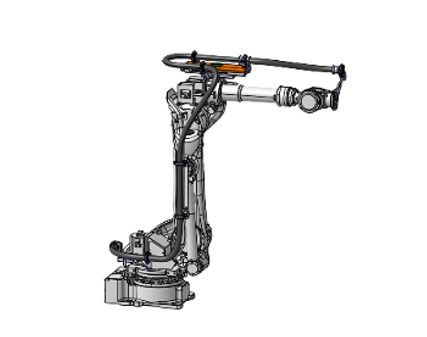
Series 5
Telescopic bracket
Compact storage where the cell envelope is tight.
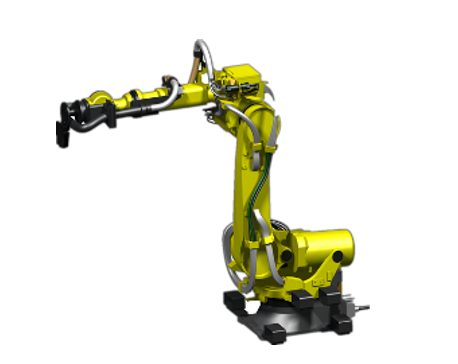
Series 6
C-flange
Body-following route with a defined maintenance opening.
What we need to answer usefully.
- Robot brand, exact model, payload, reach and controller version
- Tool, gripper, changer and full change cycle
- Cable and hose bundle diameter, weight and minimum bend radius
- Adjacent robot and fixture envelopes
- Available fixing points on the arm and tool
- Service method and connector access
Before the kick-off call.
Can a standard series be used on a collaborative robot?
It can be evaluated, but the flange, J3/J4 fixing points and wrist envelope must be checked for the exact model.
Why is mass more important in 3C?
Small robots have less payload margin. Added route mass can affect speed, accuracy and the tool that can be used.
How can adjacent robots avoid cable interference?
Review the cell layout and all robot motion envelopes together, not each robot in isolation.
Can the route support quick tool changes?
Yes, if cable slack, connector access and the full change cycle are designed and trial-fitted. The route should not rely on the operator holding the bundle clear.
Start with the robot and the thing that goes wrong.
We will turn the brief into a reference architecture, a list of unknowns and a drawing path.